












This event has been postponed!
To align with EU policy priorities, the decision has been taken to postpone this event until Q4 2025.
Further details coming soon.
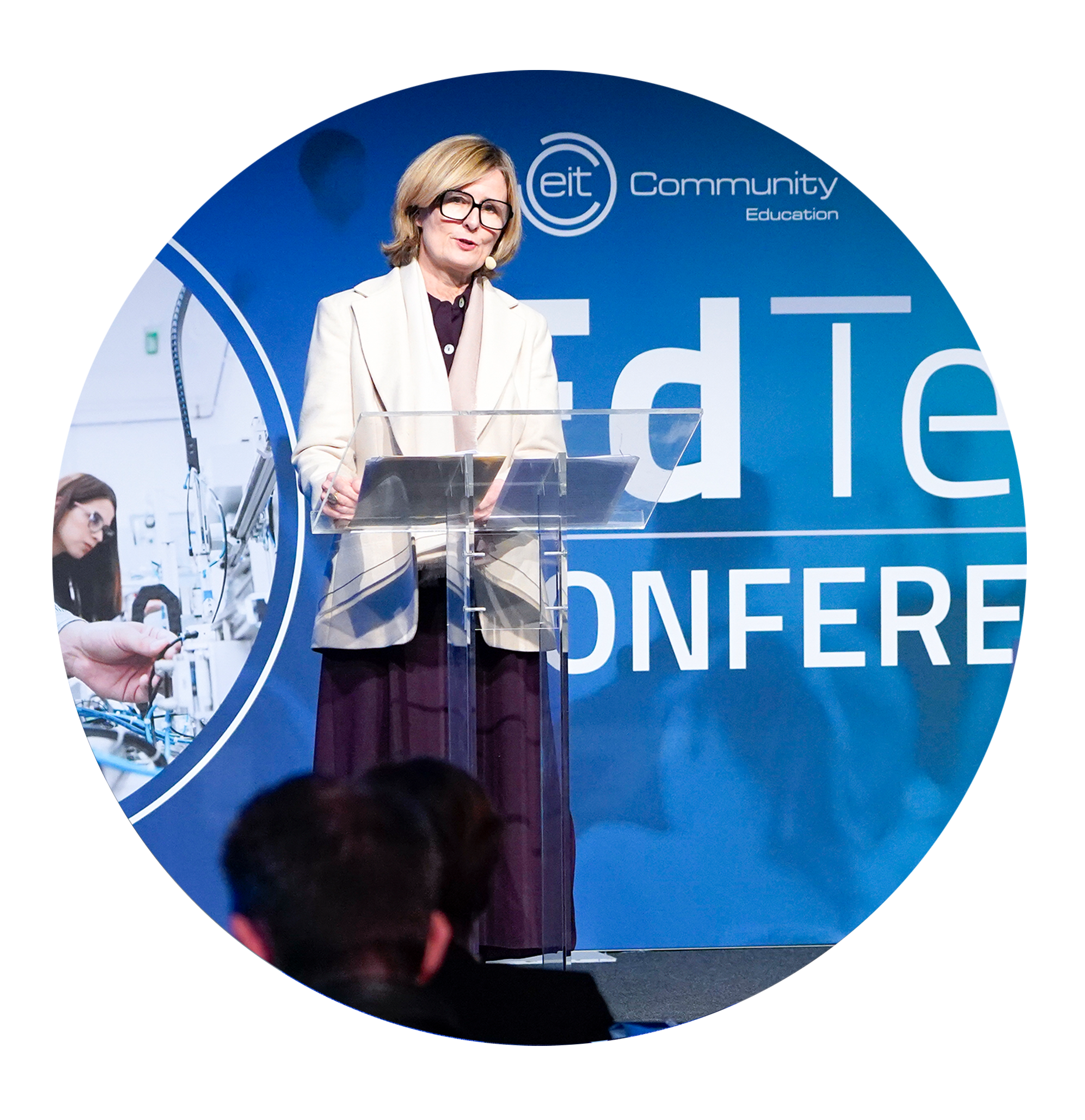
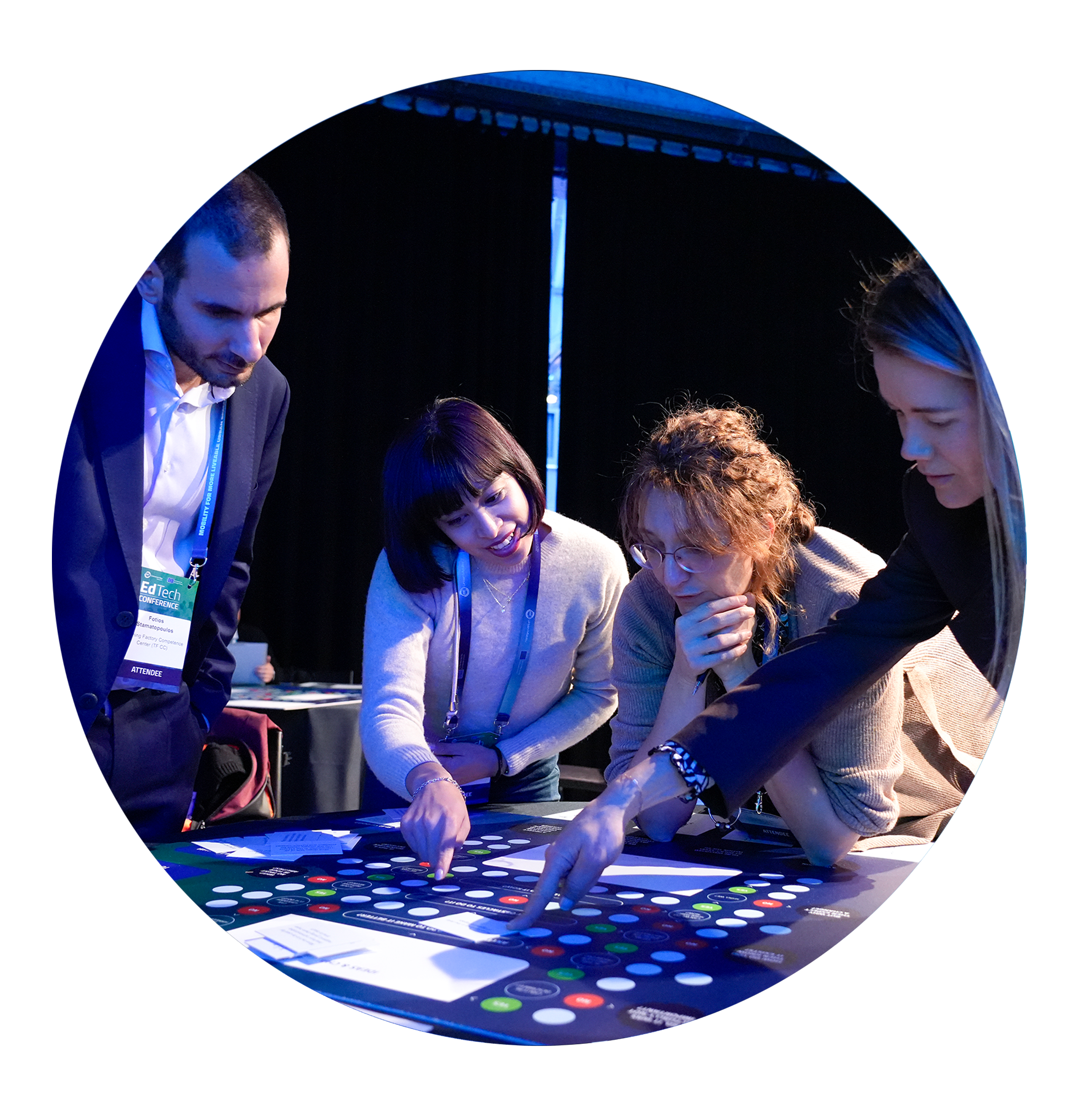
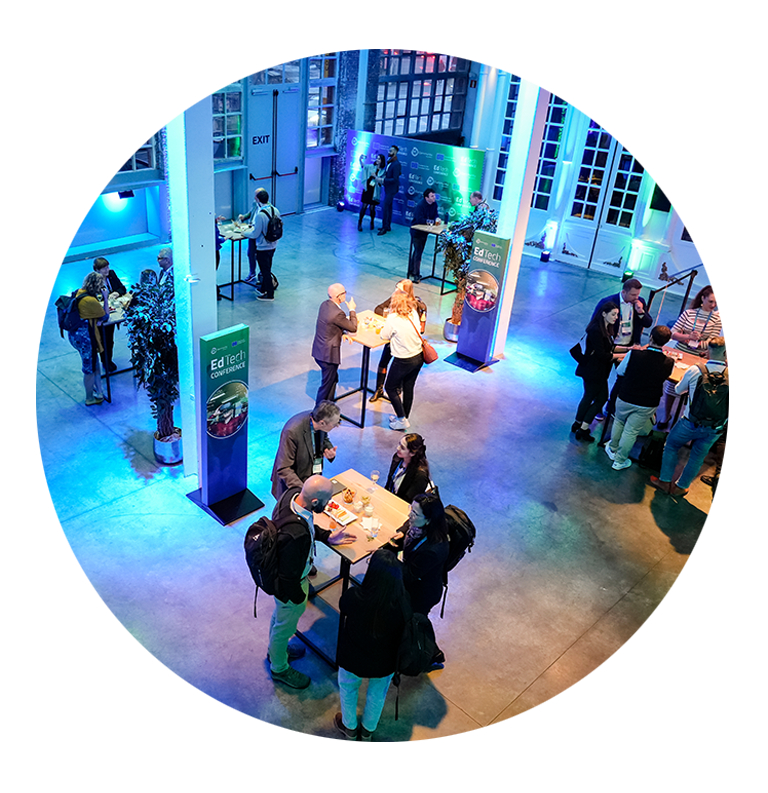
The EIT EdTech Conference overarching goal was to support the European EdTech ecosystem and contribute to make EdTech the next European success story. Recognising the dynamic yet fragmented nature of the EdTech landscape, this event served as a platform for connection and collaboration. Building upon the conclusions of its first edition in 2024, the EIT EdTech Conference 2025 bought together key stakeholders from across the education and innovation communities – including industry leaders, startups, public sector representatives, universities and schools – to explore synergies, share best practices and discuss policies that are crucial to drive impactful innovation in digital education.
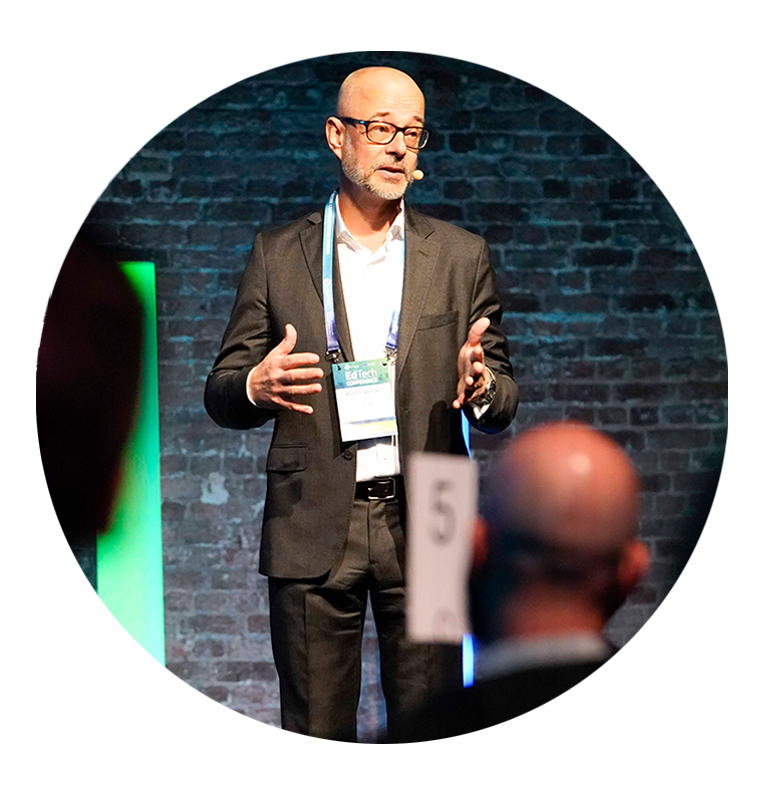
The event featured a distinctive programme combining keynote speakers, high-level panel discussions and workshop sessions, this event aimed to amplify existing success stories, foster strategic partnerships and bring the EIT Community closer to the EdTech ecosystem as a strong supporter to build a more cohesive and stronger European EdTech.
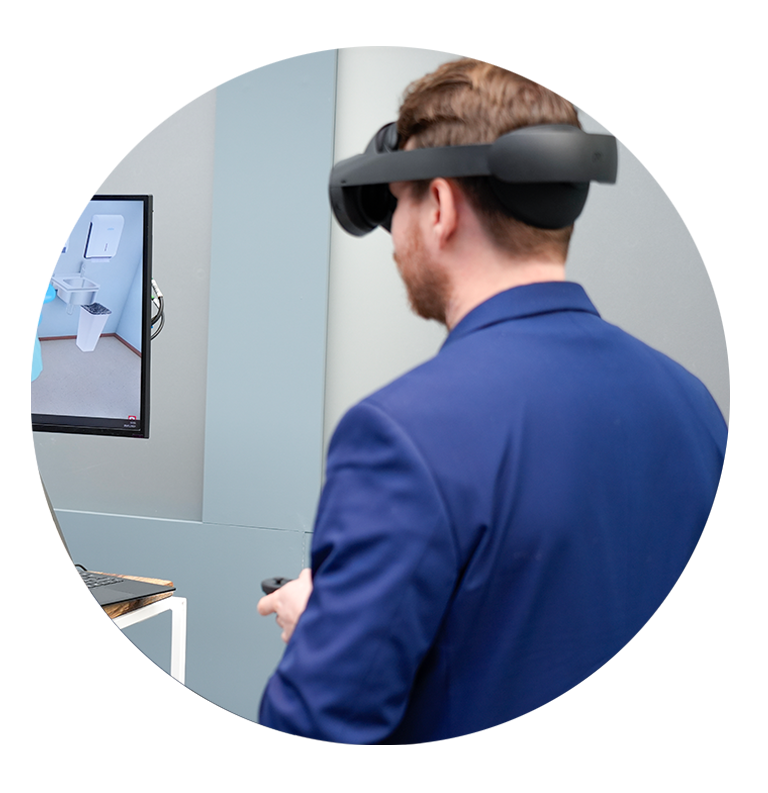
Discover cutting-edge technologies improving digital skills and education quality, featuring projects funded by Horizon Europe and the EIT.
Highlight the importance of cross-sector collaborations between public institutions, private companies, and educational entities to drive funding and innovation in EdTech.
Address the digital transition in education by showcasing training programmes, policy recommendations, and solutions that support teachers in adopting and effectively using EdTech tools.
Learn how successful EdTech initiatives can expand across Europe through collaboration and sharing best practices.
Identify the digital bottlenecks preventing EdTech adoption and explore strategies for improving infrastructure and accessibility.
Promote initiatives and technologies that ensure equitable access to digital learning opportunities for all learners.
Discuss the opportunities and challenges of AI in education, focusing on privacy, bias, and ethical implications under the EU’s AI regulatory framework.
Gain insights from top European EdTech companies on growth strategies, market impact, and overcoming industry challenges.
Whilst we put together all of the key information for the 2025 Event Report, take a look at the report that was created from the first edition of the event.
By highlighting existing initiatives, solutions and emerging trends to a broad audience, the conference will facilitate discussions between EdTech industry and startups, policymakers at national and European levels, educators, students and potential funders.
The conference will engage with policymakers to shape supportive policies, highlight funding opportunities, and incentivize the creation of EdTech-specific accelerator programmes, ultimately aiming to elevate European EdTech on a global scale.
By fostering collaboration between universities and EdTech companies, showcasing solutions that support educators, and influencing decision-makers to invest in EdTech training programmes for teaching staff, the conference aims to support the integration of EdTech solutions into European education.
By exploring the role of EdTech in meeting EU skills priorities and the goals of the Digital Education Action Plan. It will drive discussions on policies and EdTech solutions that enhance employability, support workforce transformation, and ensure accessible digital education for all.
The EdTech Committee is a specialised group of EdTech experts convened to offer guidance on content development for the upcoming EIT EdTech Conference 2025 to ensure comprehensive coverage of essential topics and discussions relevant to the sector.
Simona Petkova, Policy Officer, Digital Education’ Unit, DG EAC, European Commission Simona Petkova is part of the ‘Digital Education’ Unit of the European Commission, which is tasked with the implementation of the Digital Education Action Plan 2021-2027.
Currently, Simona coordinates the policy response to the use of Artificial Intelligence in education and training and is in charge of boosting digital literacy and building resilience to disinformation though education. She also oversees the support for the European Education Technology (EdTech) sector and its effective integration into the European digital education ecosystem.
Previously, Simona oversaw stakeholder engagement and strategic communications as well as the implementation of the Digital Education Hackathon.
Prior to joining the Commission in 2017, Simona gained experience in other international organisations, where she worked on bridging the gender digital divide. She holds MSc in Media and Communications Governance from the London School of Economics and Political Science and BSc (Hons) in Media Studies and Sociology from City, University of London.
Svenia Busson, Edtech Ecosystem Builder Svenia Busson is a global Learning Innovation explorer, speaker & ecosystem builder. She travelled 19 countries to find the most innovative teaching and learning practices. She is the author of ‘Exploring the Future of Education’ a book about education innovations from Europe, founded two industry associations: Edtech France and the European Edtech Alliance and is the programme manager of programmes dedicated to the growth of Edtech founders such as the Female Edtech Fellowship – Europe, Break into the US and Raise: Edtech.
Sean O'Reilly, Manager, Academic Affairs and Data, Technological Higher Education Association Sean O’Reilly works with the national representative association for Ireland’s technological universities (Technological Universities Association, TUA) and with predecessor bodies since 2012, in a number of roles supporting the rapidly evolving sector in strategic, data-driven decision-making, change management and quality enhancement. Sean was a member of the Steering Board for a €40m National Recovery and Resilience Programme in technological universities, funded by #NextGenerationEU. The programme focused on empowering students, developing staff capabilities, enhancing the digital ecosystem, and sustaining impact (www.transforminglearning.ie)
Prior to returning to Ireland, Sean worked for almost 20 years with schools in the United Kingdom, and spent 7 years leading ICT developments for 130 schools and acting as school inspector. This role included setting strategic direction for primary and secondary schools’ use of ICT, and managing a EU-funded project to invest in 600 sites, including SMEs, across a sub-region.
Ilaria Tagliavini, Head of Operations, EIT Ilaria manages the units in charge of Innovation, Education, and Communication at the seat of the EIT in Budapest.
She has over 20 years’ experience in Business Development & Innovation Management in Multinational companies, Innovation Consultancy firms and hi-tech Startups.
Ilaria began her career at Whirlpool Corporation, where she held different managerial positions in Customer Service and Marketing and led the EMEA Innovation Team. She then worked as Head of Business Development and Grants Management for an Engineering Consulting firm, building her experience in European Grants strategies and submissions, with proven successes.
She was then Senior Partner at Great Product Ventures Inc, a US based venture development firm. Ilaria is a Startup’s business developer, mentor, and advisor and has put together an extensive network of relations with major crowdfunding entities, VC players, Accelerators & Incubators, and many valuable startups at international level.
In the last 10 years, Ilaria is also a Lecturer at LIUC University (Italy), teaching Innovation Management at the Faculty of Economics and Innovation & Industrial Design at the Faculty of Engineering.
Ilaria holds an Msc in Economics from Università Cattolica di Milano.
Peter Fagerström, Accelerator lead for the European Digital Education Hub, Educraftor Founder and Executive Chairman at Educraftor, Founder and CEO at Teach millions, Accelerator Programme Lead at the European Digital Education Hub.
Ilaria manages the units in charge of Innovation, Education, and Communication at the seat of the EIT in Budapest.
She began her career at Whirlpool Corporation, where she held different managerial positions in Customer Service and Marketing and led the EMEA Innovation Team. She then worked as Head of Business Development and Grants Management for an Engineering Consulting firm, building her experience in European Grants strategies and submissions, with proven successes.
She was then Senior Partner at Great Product Ventures Inc, a US based venture development firm. Ilaria is a Startup’s business developer, mentor, and advisor and has put together an extensive network of relations with major crowdfunding entities, VC players, Accelerators & Incubators, and many valuable startups at international level.
In the last 10 years, Ilaria is also a Lecturer at LIUC University (Italy), teaching Innovation Management at the Faculty of Economics and Innovation & Industrial Design at the Faculty of Engineering.
Ilaria holds an Msc in Economics from Università Cattolica di Milano.
Dr. Martin Vendel holds the position as Academy Director at EIT Urban Mobility. He has experience from academic research and teaching combined with industrial experience from large multinational corporations and startups. Dr. Vendel has experience from a number of executive and board positions, with a focus on corporate strategy, marketing, business development and industry transformation. The last years with a focus on technology driven transformation and change.
Set the tone for the day and uplift the conversation with high level keynote on EU education policy priorities and the positioning of EdTech in those.
Antoaneta Angelova-Krasteva is Director for Innovation, Digital Education and International
Cooperation at the European Commission. She is responsible for the coordination and
implementation of the EU Digital Education Action Plan, the international dimension of the Erasmus+
programme, as well as the Marie Skłodowska-Curie Actions (MSCA) and the European Institute of
Innovation and Technology, which are integral parts of the Horizon Europe Programme.
Antoaneta joined the European Commission in 2008. She has worked across various Commission
services on a wide range of topics such as external relations and enlargement, internal security and
police cooperation, digital matters and cyber security, stakeholder engagement. Before joining the
Commission, Antoaneta had spent 10 years in the Bulgarian public administration, including as
diplomat at the Permanent Representation of Bulgaria in Brussels, dealing mainly with justice and
home affairs issues.
Antoaneta is a graduate in political science of Sofia University “St Kliment Ohridski” (Bulgaria), with
training and qualifications in European studies from Germany (Wissenschaftszentrum Berlin für
Sozialforschung) and the UK (Sussex University).
Since 2019, Emma Linsenmayer is an Analyst in the Research, Development and Innovation (RDI) team of the Programme for International Student Assessment (PISA) at the OECD, contributing to the development and implementation of innovative assessment frameworks, with a particular focus on 21st century skills. She plays a central role in the design of the Learning in the Digital World assessment (PISA 2025), collaborating closely with international experts to design technology-enhanced activities that allow us to evaluate complex, process-based competences in large-scale assessments.
She also leads the OECD Platform for Innovative Learning Assessments (PILA), an open-source initiative that supports the use of formative, technology-enhanced assessments in classroom settings. PILA aims to bridge assessment innovation and pedagogical practice, enabling more personalised and inclusive learning experiences.
In addition to her work on PISA, she has contributed to the OECD’s Education for Inclusive Societies project. Her policy analysis focuses on how artificial intelligence can affect students with special education needs.
Panelists will exchange thought-provoking insights on how strategic collaboration between public institutions, private companies, and educational entries are shaping innovation and funding in European EdTech.
Founder and Executive Chairman at Educraftor, Founder and CEO at Teach millions, Accelerator Programme Lead at the European Digital Education Hub.
Märt Aro’s involvement in the field of education development dates back to his secondary school years which saw Märt organising educational events for peers on a national level.
Since 2004, Märt has established numerous organisations and companies in the area of education development.
Märt is the co-founder of DreamApply.com Student Application Management Platform, launched in 2011. DreamApply is used by more than 300 universities from across 40 countries, serving millions of users annually.
Märt is serving as Chairman of the Board at NGO EdTech Estonia that brings together 50+ founders of education innovation initiatives from Estonia with the aim of sharing experience and fostering cooperation.
In order to drive education forward Märt regularly collaborates with: United Nations, European Union, Estonian Ministry of Education and Research, and many others.
Jannie has extensive experience working with digital competence, pedagogy, and management, both as an educator, principal, and head of professional development. She has been appointed commissioner to the Swedish Government’s strategic cooperation programme on Skills and Lifelong Learning and has advised the Swedish National Agency for Higher Vocational Education and Swedish Public Employment Agency as a member of their Innovation Advisory Boards. Jannie is the CEO of Swedish EdTech Industry and Chair of The European EdTech Alliance (EEA), an umbrella organisation of European associations connecting the European EdTech ecosystem and representing more than 2500 EdTech companies.
Jitske van Os is Managing Director of Dutch EdTech, where she leads the Dutch EdTech community and supports entrepreneurs in growing and scaling internationally. With over a decade of experience in ecosystem building, strategic project management, and stakeholder engagement, she has worked with 500+ startups and scale-ups to accelerate innovation. Previously, she held leadership roles at Techleap.nl, StartupDelta, and Tech Tour, developing international growth programs, forging strategic partnerships, and driving impactful collaborations between entrepreneurs, investors, and policymakers. Passionate about connecting people and creating opportunities, Jitske thrives at the intersection of strategy and execution to deliver lasting impact in education and techn
Panelists will explore how technology supports skills development and digital literacy in Europe, and how these goals align with current European policy priorities. The discussion will highlight practical approaches and lessons learned form real-world experiences.
Dr Sharon Flynn was the National Co-ordinator of N-TUTORR (2022-2025), an ambitious programme of work funded by the European Union and NextGenerationEU. In her role, she worked closely with senior academic leaders in seven partner HEIs to transform teaching and learning in the technological higher education sector in Ireland. Dr Flynn has experience working at a national level, leading the Irish Universities Association’s Enhancing Digital Teaching and Learning (EDTL) project between 2019 and 2022. Previously, she was Assistant Director of the Centre for Excellence in Learning and Teaching at the University of Galway between 2006 and 2019. In July 2025 she took up the role as Manager of the Research Institute for Creativity at the University of Galway. With a PhD in Computing Science from the University of Glasgow, Scotland, she has almost 30 years experience working in higher education in Ireland.
Michaela Horvathova is an international education expert with extensive experience in education reform and future skills development. As Co-founder and Chief Education Officer at Beyond Education, she leads an edtech startup focused on preparing students for the future by assessing and cultivating 21st-century skills online. Her career includes advising the Prime Minister of Slovakia on education reform and spearheading transformative educational projects for the 21st century with the Center for Curriculum Redesign in Brazil, South Africa, and the Netherlands. She has also worked as a policy analyst at the OECD and as a consultant for organizations such as UNICEF, the International Baccalaureate, and The Future Society, emphasizing her commitment to leveraging education as a catalyst for societal progress and preparing students to meet the challenges of the future. Michaela holds a Master’s degree in International Education Policy from Harvard University.
Lana is the President of the European Students’ Union (ESU) for the 2025/26 mandate. She has been actively involved in the student movement for over five years, beginning as president of the student council at the University of Rijeka. As a member of the Croatian Students’ Council, she engaged in national and European-level advocacy on a wide range of student issues. Prior to becoming president, Lana served as Vice-President of ESU during the 2024/25 term and was a member of its Executive Committee since October 2023. In these roles, she worked extensively on topics related to enhancing the Quality of Education and the development of the European Education Area. As president, Lana focuses on advancing the European Education Area and strengthening the Organizational Development and Capacity Building. She is committed to fostering a more inclusive, innovative, and student-driven higher education landscape across Europe.
Get to know EIT Community initiatives and their potential to include EdTech.
Pamela Pokorny is an inclusive education specialist with a background spanning instructional design, EU policy, and edtech. She leads the Digital Learning Unit at EIT Food, where she oversees a program reaching over 200,000 online learners. Her work focuses on developing accessible, scalable learning experiences, including innovations in 3D and augmented reality platforms and microlearning strategies. Pamela has led cross-functional teams in both academic and applied settings, advancing lifelong learning in the context of agrifood system transformation.
Gerard is an education professional with experience in policy, research, and programme design and implementation. He has worked in think tanks, government agencies, ministries, higher education and the third sector. His current role is Head of Education Capacity Building at EIT Urban Mobility, where he leads the organisation’s participation in EIT Community education programmes and is responsible for projects in moderate and modest innovation countries. He is in charge of the strategic development of the EIT Campus, the online platform that brings together the EIT KICs’ education offer and has attracted over 200,000 users since 2023.
Prof. Redford is an internationally recognized expert on entrepreneurship, innovation and AI-enabled EdTech. He serves as President of the NGO PEEP where he focuses on evidence-based policymaking in education reform and economic development.
Dr. Redford has worked extensively with the EIT as a lead educator, expert and evaluator across multiple KICs, including EIT Climate-KIC, EIT Food, EIT Manufacturing, EIT Urban Mobility and EIT RawMaterials. He played a central role in the EIT Label Framework and has advised on capacity building, quality assurance and innovation ecosystems across Europe and beyond.
He is a Senior Fellow at the University of California, Berkeley researching Gen Z entrepreneurs. He has worked as an expert for the European Commission, the U.S. government, UNDP, UNIDO and the OECD. He is a Member of the Advisory Board of the EIT Deep Tech Talent Initiative and has authored several books on the Entrepreneurial University, High Impact Entrepreneurship and Financial Inclusion.
Curated by the European EdTech Alliance, this dynamic session will spotlight the continued resilience of the European EdTech ecosystem by presenting a series of implementation stories, successful European projects and an audience-led exploration of ‘what’s still missing’ to address persistent challenges.
Originally a high school teacher from Australia, Beth Havinga has managed education publishing houses and education software companies in Europe, founded her own EdTech startups in Germany and the USA, and, for the last six years, has supported a wide variety of education organisations through her company, Connect EdTech. Beth works with large tech corporations, education publishers, governments, ministries of education and education startups globally, supporting them in education policy, digital implementation strategies, market analyses, and the internationalisation and expansion of digital products. She currently serves on the practical advisory board of Kids.digilab.Berlin.
As a specialist in the digitisation and interoperability of education systems, Beth currently serves on the Digitisation Council of the state of Berlin in Germany, is chair of the advisory board of Kids.Digilab.Berlin, and also represents Germany as head delegate to the European Committee for Standardization of Interoperability for Learning Technologies and EdTech. Additionally, Beth is part of the EdTech Roundtable of the European Commission, represents the EEA as part of UNESCO’s Broadband Commission, and is part of the COSN international advisory board.
Beth has previously served on the expert committee of the Austrian Ministry of Economy, Research and Science, and was an invited member of the expert Platform, “Digital Future: Learning. Researching. Knowledge” of the German Digital Summit under the Chairmanship of the German Education Minister.
As a cofounder of the European Edtech Alliance, Beth is excited about making the digital education landscape within Europe more accessible, interconnected and open for innovation.
Biography to follow
Christina Makarona, PhD, acts as project coordinator in the Science Education Department at European Schoolnet, overseeing the EmpowerED project, EUN’s main initiative on EdTech. She has a background in STE(A)M pedagogies in secondary education, interdisciplinary studies is higher education and in science communication.
Anne-Wil Kramer is a postdoctoral researcher at Radboud University and part of the Dutch National Education Lab AI (NOLAI), where she studies teacher AI collaboration and works with schools and EdTech partners to co-create and implement AI in daily teaching practices.
Designed to spark meaningful conversations, each Lab will gather insights, recommendations, and innovative ideas from participants, while also exploring key collaboration opportunities.
As Education Director at EIT Culture & Creativity, I work with my team to commission degree education courses, continuous professional development skills and training, as well as important EIT cross-KIC initiatives such as the HEI, Girls Go STEM, EIT STEM Tech Talent Induction, EIT CAMPUS, and EIT CONNECT. Our work focuses on unlocking the transformative potential of culture and creativity to foster innovative education, research, and entrepreneurship across and beyond EIT’s existing Knowledge and Innovation Communities. I am particularly interested in how the cultural and creative sectors and industries can pioneer responses to EC priorities such as security and resilience, climate change and the environment, health, inequality, and democratic engagement.
With a career spanning artistic and design innovation and strategic leadership across academia, research, and policy, I have served as Director of Research at Konstfack University College of Arts, Crafts and Design and Stockholm University of the Arts. I have held senior professorships in artistic research in Sweden and in the epistemology of design-led research in Belgium. I was twice elected Vice-President of the international Society for Artistic Research.
I work as an evaluator for the European Research Council, Horizon Europe, and national research councils in Sweden, Norway, Portugal, and Austria, and have chaired expert panels for the Norwegian Ministry of Education and Research assessing universities seeking Centres of Excellence in Higher Education.
Beyond the academy, I maintain an international profile in experimental architecture and interdisciplinary storytelling. As a member of the Experimental Architecture Group, led by Rachel Armstrong, my creative work on microbial architecture—spanning publications, performances, and exhibitions—has been presented at major biennales and cultural institutions worldwide. I am also part of the “Emerging Bio-Age” expert group at Chatham House, London, contributing to cross-sectoral dialogues on the intersections of biology, technology, and design.
Dr. Martin Vendel holds the position as Academy Director at EIT Urban Mobility. He has experience from academic research and teaching combined with industrial experience from large multinational corporations and startups. Dr. Vendel has experience from a number of executive and board positions, with a focus on corporate strategy, marketing, business development and industry transformation. The last years with a focus on technology driven transformation and change.
Ilaria manages the units in charge of Innovation, Education, and Communication at the seat of the EIT in Budapest.
She began her career at Whirlpool Corporation, where she held different managerial positions in Customer Service and Marketing and led the EMEA Innovation Team. She then worked as Head of Business Development and Grants Management for an Engineering Consulting firm, building her experience in European Grants strategies and submissions, with proven successes.
She was then Senior Partner at Great Product Ventures Inc, a US based venture development firm. Ilaria is a Startup’s business developer, mentor, and advisor and has put together an extensive network of relations with major crowdfunding entities, VC players, Accelerators & Incubators, and many valuable startups at international level.
In the last 10 years, Ilaria is also a Lecturer at LIUC University (Italy), teaching Innovation Management at the Faculty of Economics and Innovation & Industrial Design at the Faculty of Engineering.
Ilaria holds an Msc in Economics from Università Cattolica di Milano.
Dr. Martin Vendel holds the position as Academy Director at EIT Urban Mobility. He has experience from academic research and teaching combined with industrial experience from large multinational corporations and startups. Dr. Vendel has experience from a number of executive and board positions, with a focus on corporate strategy, marketing, business development and industry transformation. The last years with a focus on technology driven transformation and change.
Set the tone for the day and uplift the conversation with high level keynote on EU education policy priorities and the positioning of EdTech in those.

Antoaneta Angelova-Krasteva is Director for Innovation, Digital Education and International
Cooperation at the European Commission. She is responsible for the coordination and
implementation of the EU Digital Education Action Plan, the international dimension of the Erasmus+
programme, as well as the Marie Skłodowska-Curie Actions (MSCA) and the European Institute of
Innovation and Technology, which are integral parts of the Horizon Europe Programme.
Antoaneta joined the European Commission in 2008. She has worked across various Commission
services on a wide range of topics such as external relations and enlargement, internal security and
police cooperation, digital matters and cyber security, stakeholder engagement. Before joining the
Commission, Antoaneta had spent 10 years in the Bulgarian public administration, including as
diplomat at the Permanent Representation of Bulgaria in Brussels, dealing mainly with justice and
home affairs issues.
Antoaneta is a graduate in political science of Sofia University “St Kliment Ohridski” (Bulgaria), with
training and qualifications in European studies from Germany (Wissenschaftszentrum Berlin für
Sozialforschung) and the UK (Sussex University).
Since 2019, Emma Linsenmayer is an Analyst in the Research, Development and Innovation (RDI) team of the Programme for International Student Assessment (PISA) at the OECD, contributing to the development and implementation of innovative assessment frameworks, with a particular focus on 21st century skills. She plays a central role in the design of the Learning in the Digital World assessment (PISA 2025), collaborating closely with international experts to design technology-enhanced activities that allow us to evaluate complex, process-based competences in large-scale assessments.
She also leads the OECD Platform for Innovative Learning Assessments (PILA), an open-source initiative that supports the use of formative, technology-enhanced assessments in classroom settings. PILA aims to bridge assessment innovation and pedagogical practice, enabling more personalised and inclusive learning experiences.
In addition to her work on PISA, she has contributed to the OECD’s Education for Inclusive Societies project. Her policy analysis focuses on how artificial intelligence can affect students with special education needs.
Panelists will exchange thought-provoking insights on how strategic collaboration between public institutions, private companies, and educational entries are shaping innovation and funding in European EdTech.
Founder and Executive Chairman at Educraftor, Founder and CEO at Teach millions, Accelerator Programme Lead at the European Digital Education Hub.
Märt Aro’s involvement in the field of education development dates back to his secondary school years which saw Märt organising educational events for peers on a national level.
Since 2004, Märt has established numerous organisations and companies in the area of education development.
Märt is the co-founder of DreamApply.com Student Application Management Platform, launched in 2011. DreamApply is used by more than 300 universities from across 40 countries, serving millions of users annually.
Märt is serving as Chairman of the Board at NGO EdTech Estonia that brings together 50+ founders of education innovation initiatives from Estonia with the aim of sharing experience and fostering cooperation.
In order to drive education forward Märt regularly collaborates with: United Nations, European Union, Estonian Ministry of Education and Research, and many others.
Jannie has extensive experience working with digital competence, pedagogy, and management, both as an educator, principal, and head of professional development. She has been appointed commissioner to the Swedish Government’s strategic cooperation programme on Skills and Lifelong Learning and has advised the Swedish National Agency for Higher Vocational Education and Swedish Public Employment Agency as a member of their Innovation Advisory Boards. Jannie is the CEO of Swedish EdTech Industry and Chair of The European EdTech Alliance (EEA), an umbrella organisation of European associations connecting the European EdTech ecosystem and representing more than 2500 EdTech companies.
Jitske van Os is Managing Director of Dutch EdTech, where she leads the Dutch EdTech community and supports entrepreneurs in growing and scaling internationally. With over a decade of experience in ecosystem building, strategic project management, and stakeholder engagement, she has worked with 500+ startups and scale-ups to accelerate innovation. Previously, she held leadership roles at Techleap.nl, StartupDelta, and Tech Tour, developing international growth programs, forging strategic partnerships, and driving impactful collaborations between entrepreneurs, investors, and policymakers. Passionate about connecting people and creating opportunities, Jitske thrives at the intersection of strategy and execution to deliver lasting impact in education and techn
Panelists will explore how technology supports skills development and digital literacy in Europe, and how these goals align with current European policy priorities. The discussion will highlight practical approaches and lessons learned form real-world experiences.
Dr Sharon Flynn was the National Co-ordinator of N-TUTORR (2022-2025), an ambitious programme of work funded by the European Union and NextGenerationEU. In her role, she worked closely with senior academic leaders in seven partner HEIs to transform teaching and learning in the technological higher education sector in Ireland. Dr Flynn has experience working at a national level, leading the Irish Universities Association’s Enhancing Digital Teaching and Learning (EDTL) project between 2019 and 2022. Previously, she was Assistant Director of the Centre for Excellence in Learning and Teaching at the University of Galway between 2006 and 2019. In July 2025 she took up the role as Manager of the Research Institute for Creativity at the University of Galway. With a PhD in Computing Science from the University of Glasgow, Scotland, she has almost 30 years experience working in higher education in Ireland.
Michaela Horvathova is an international education expert with extensive experience in education reform and future skills development. As Co-founder and Chief Education Officer at Beyond Education, she leads an edtech startup focused on preparing students for the future by assessing and cultivating 21st-century skills online. Her career includes advising the Prime Minister of Slovakia on education reform and spearheading transformative educational projects for the 21st century with the Center for Curriculum Redesign in Brazil, South Africa, and the Netherlands. She has also worked as a policy analyst at the OECD and as a consultant for organizations such as UNICEF, the International Baccalaureate, and The Future Society, emphasizing her commitment to leveraging education as a catalyst for societal progress and preparing students to meet the challenges of the future. Michaela holds a Master’s degree in International Education Policy from Harvard University.
Lana is the President of the European Students’ Union (ESU) for the 2025/26 mandate. She has been actively involved in the student movement for over five years, beginning as president of the student council at the University of Rijeka. As a member of the Croatian Students’ Council, she engaged in national and European-level advocacy on a wide range of student issues. Prior to becoming president, Lana served as Vice-President of ESU during the 2024/25 term and was a member of its Executive Committee since October 2023. In these roles, she worked extensively on topics related to enhancing the Quality of Education and the development of the European Education Area. As president, Lana focuses on advancing the European Education Area and strengthening the Organizational Development and Capacity Building. She is committed to fostering a more inclusive, innovative, and student-driven higher education landscape across Europe.
Get to know EIT Community initiatives and their potential to include EdTech.
Pamela Pokorny is an inclusive education specialist with a background spanning instructional design, EU policy, and edtech. She leads the Digital Learning Unit at EIT Food, where she oversees a program reaching over 200,000 online learners. Her work focuses on developing accessible, scalable learning experiences, including innovations in 3D and augmented reality platforms and microlearning strategies. Pamela has led cross-functional teams in both academic and applied settings, advancing lifelong learning in the context of agrifood system transformation.
Gerard is an education professional with experience in policy, research, and programme design and implementation. He has worked in think tanks, government agencies, ministries, higher education and the third sector. His current role is Head of Education Capacity Building at EIT Urban Mobility, where he leads the organisation’s participation in EIT Community education programmes and is responsible for projects in moderate and modest innovation countries. He is in charge of the strategic development of the EIT Campus, the online platform that brings together the EIT KICs’ education offer and has attracted over 200,000 users since 2023.
Prof. Redford is an internationally recognized expert on entrepreneurship, innovation and AI-enabled EdTech. He serves as President of the NGO PEEP where he focuses on evidence-based policymaking in education reform and economic development.
Dr. Redford has worked extensively with the EIT as a lead educator, expert and evaluator across multiple KICs, including EIT Climate-KIC, EIT Food, EIT Manufacturing, EIT Urban Mobility and EIT RawMaterials. He played a central role in the EIT Label Framework and has advised on capacity building, quality assurance and innovation ecosystems across Europe and beyond.
He is a Senior Fellow at the University of California, Berkeley researching Gen Z entrepreneurs. He has worked as an expert for the European Commission, the U.S. government, UNDP, UNIDO and the OECD. He is a Member of the Advisory Board of the EIT Deep Tech Talent Initiative and has authored several books on the Entrepreneurial University, High Impact Entrepreneurship and Financial Inclusion.
Curated by the European EdTech Alliance, this dynamic session will spotlight the continued resilience of the European EdTech ecosystem by presenting a series of implementation stories, successful European projects and an audience-led exploration of ‘what’s still missing’ to address persistent challenges.
Originally a high school teacher from Australia, Beth Havinga has managed education publishing houses and education software companies in Europe, founded her own EdTech startups in Germany and the USA, and, for the last six years, has supported a wide variety of education organisations through her company, Connect EdTech. Beth works with large tech corporations, education publishers, governments, ministries of education and education startups globally, supporting them in education policy, digital implementation strategies, market analyses, and the internationalisation and expansion of digital products. She currently serves on the practical advisory board of Kids.digilab.Berlin.
As a specialist in the digitisation and interoperability of education systems, Beth currently serves on the Digitisation Council of the state of Berlin in Germany, is chair of the advisory board of Kids.Digilab.Berlin, and also represents Germany as head delegate to the European Committee for Standardization of Interoperability for Learning Technologies and EdTech. Additionally, Beth is part of the EdTech Roundtable of the European Commission, represents the EEA as part of UNESCO’s Broadband Commission, and is part of the COSN international advisory board.
Beth has previously served on the expert committee of the Austrian Ministry of Economy, Research and Science, and was an invited member of the expert Platform, “Digital Future: Learning. Researching. Knowledge” of the German Digital Summit under the Chairmanship of the German Education Minister.
As a cofounder of the European Edtech Alliance, Beth is excited about making the digital education landscape within Europe more accessible, interconnected and open for innovation.
Biography to follow
Christina Makarona, PhD, acts as project coordinator in the Science Education Department at European Schoolnet, overseeing the EmpowerED project, EUN’s main initiative on EdTech. She has a background in STE(A)M pedagogies in secondary education, interdisciplinary studies is higher education and in science communication.
Anne-Wil Kramer is a postdoctoral researcher at Radboud University and part of the Dutch National Education Lab AI (NOLAI), where she studies teacher AI collaboration and works with schools and EdTech partners to co-create and implement AI in daily teaching practices.
Designed to spark meaningful conversations, each Lab will gather insights, recommendations, and innovative ideas from participants, while also exploring key collaboration opportunities.
As Education Director at EIT Culture & Creativity, I work with my team to commission degree education courses, continuous professional development skills and training, as well as important EIT cross-KIC initiatives such as the HEI, Girls Go STEM, EIT STEM Tech Talent Induction, EIT CAMPUS, and EIT CONNECT. Our work focuses on unlocking the transformative potential of culture and creativity to foster innovative education, research, and entrepreneurship across and beyond EIT’s existing Knowledge and Innovation Communities. I am particularly interested in how the cultural and creative sectors and industries can pioneer responses to EC priorities such as security and resilience, climate change and the environment, health, inequality, and democratic engagement.

With a career spanning artistic and design innovation and strategic leadership across academia, research, and policy, I have served as Director of Research at Konstfack University College of Arts, Crafts and Design and Stockholm University of the Arts. I have held senior professorships in artistic research in Sweden and in the epistemology of design-led research in Belgium. I was twice elected Vice-President of the international Society for Artistic Research.
I work as an evaluator for the European Research Council, Horizon Europe, and national research councils in Sweden, Norway, Portugal, and Austria, and have chaired expert panels for the Norwegian Ministry of Education and Research assessing universities seeking Centres of Excellence in Higher Education.
Beyond the academy, I maintain an international profile in experimental architecture and interdisciplinary storytelling. As a member of the Experimental Architecture Group, led by Rachel Armstrong, my creative work on microbial architecture—spanning publications, performances, and exhibitions—has been presented at major biennales and cultural institutions worldwide. I am also part of the “Emerging Bio-Age” expert group at Chatham House, London, contributing to cross-sectoral dialogues on the intersections of biology, technology, and design.
Dr. Martin Vendel holds the position as Academy Director at EIT Urban Mobility. He has experience from academic research and teaching combined with industrial experience from large multinational corporations and startups. Dr. Vendel has experience from a number of executive and board positions, with a focus on corporate strategy, marketing, business development and industry transformation. The last years with a focus on technology driven transformation and change.
Coming soon – check back for updates.
Antoaneta Angelova-Krasteva, Director for Innovation, Digital Education and International Cooperation, European Commission Antoaneta Angelova-Krasteva is Director for Innovation, Digital Education and International Cooperation at the European Commission. She is responsible for the coordination and implementation of the EU Digital Education Action Plan, the international dimension of the Erasmus+ programme, as well as the Marie Skłodowska-Curie Actions (MSCA) and the European Institute of Innovation and Technology, which are integral parts of the Horizon Europe Programme.
Antoaneta joined the European Commission in 2008. She has worked across various Commission services on a wide range of topics such as external relations and enlargement, internal security and police cooperation, digital matters and cyber security, stakeholder engagement. Before joining the Commission, Antoaneta had spent 10 years in the Bulgarian public administration, including as diplomat at the Permanent Representation of Bulgaria in Brussels, dealing mainly with justice and home affairs issues.
Antoaneta is a graduate in political science of Sofia University “St Kliment Ohridski” (Bulgaria), with training and qualifications in European studies from Germany (Wissenschaftszentrum Berlin für Sozialforschung) and the UK (Sussex University).
Ilaria Tagliavini, Head of Operations, EIT Ilaria manages the units in charge of Innovation, Education, and Communication at the seat of the EIT in Budapest.
She has over 20 years’ experience in Business Development & Innovation Management in Multinational companies, Innovation Consultancy firms and hi-tech Startups.
Ilaria began her career at Whirlpool Corporation, where she held different managerial positions in Customer Service and Marketing and led the EMEA Innovation Team. She then worked as Head of Business Development and Grants Management for an Engineering Consulting firm, building her experience in European Grants strategies and submissions, with proven successes.
She was then Senior Partner at Great Product Ventures Inc, a US based venture development firm. Ilaria is a Startup’s business developer, mentor, and advisor and has put together an extensive network of relations with major crowdfunding entities, VC players, Accelerators & Incubators, and many valuable startups at international level.
In the last 10 years, Ilaria is also a Lecturer at LIUC University (Italy), teaching Innovation Management at the Faculty of Economics and Innovation & Industrial Design at the Faculty of Engineering.
Ilaria holds an Msc in Economics from Università Cattolica di Milano.
Dr. Martin Vendel, Director Academy, EIT Urban Mobility Dr. Martin Vendel holds the position as Academy Director at EIT Urban Mobility. He has experience from academic research and teaching combined with industrial experience from large multinational corporations and startups. Dr. Vendel has experience from a number of executive and board positions, with a focus on corporate strategy, marketing, business development and industry transformation. The last years with a focus on technology driven transformation and change.
Emma Linsenmayer, Analyst on the PISA Research, Development and Innovation team, OECD Directorate for Education and Skills Since 2019, Emma Linsenmayer is an Analyst in the Research, Development and Innovation (RDI) team of the Programme for International Student Assessment (PISA) at the OECD, contributing to the development and implementation of innovative assessment frameworks, with a particular focus on 21st century skills. She plays a central role in the design of the Learning in the Digital World assessment (PISA 2025), collaborating closely with international experts to design technology-enhanced activities that allow us to evaluate complex, process-based competences in large-scale assessments.
She also leads the OECD Platform for Innovative Learning Assessments (PILA), an open-source initiative that supports the use of formative, technology-enhanced assessments in classroom settings. PILA aims to bridge assessment innovation and pedagogical practice, enabling more personalised and inclusive learning experiences.
In addition to her work on PISA, she has contributed to the OECD’s Education for Inclusive Societies project. Her policy analysis focuses on how artificial intelligence can affect students with special education needs.
Cristina Pozzi, Futures, AI, and Education Expert
Beth Havinga, Managing Director, European Edtech Alliance Originally a high school teacher from Australia, Beth Havinga has managed education publishing houses and education software companies in Europe, founded her own EdTech startups in Germany and the USA, and, for the last six years, has supported a wide variety of education organisations through her company, Connect EdTech. Beth works with large tech corporations, education publishers, governments, ministries of education and education startups globally, supporting them in education policy, digital implementation strategies, market analyses, and the internationalisation and expansion of digital products. She currently serves on the practical advisory board of Kids.digilab.Berlin.
As a specialist in the digitisation and interoperability of education systems, Beth currently serves on the Digitisation Council of the state of Berlin in Germany, is chair of the advisory board of Kids.Digilab.Berlin, and also represents Germany as head delegate to the European Committee for Standardization of Interoperability for Learning Technologies and EdTech. Additionally, Beth is part of the EdTech Roundtable of the European Commission, represents the EEA as part of UNESCO’s Broadband Commission, and is part of the COSN international advisory board.
Beth has previously served on the expert committee of the Austrian Ministry of Economy, Research and Science, and was an invited member of the expert Platform, “Digital Future: Learning. Researching. Knowledge” of the German Digital Summit under the Chairmanship of the German Education Minister.
As a cofounder of the European Edtech Alliance, Beth is excited about making the digital education landscape within Europe more accessible, interconnected and open for innovation.
Michelle DuQuette, Events & Ecosystem Strategist, European EdTech Alliance | Community Strategist, EmpowerED Biography to follow soon
Gerard Domínguez, Head of Capacity Building, EIT Campus Gerard is an education professional with experience in policy, research, and programme design and implementation. He has worked in think tanks, government agencies, ministries, higher education and the third sector. His current role is Head of Education Capacity Building at EIT Urban Mobility, where he leads the organisation’s participation in EIT Community education programmes and is responsible for projects in moderate and modest innovation countries. He is in charge of the strategic development of the EIT Campus, the online platform that brings together the EIT KICs’ education offer and has attracted over 200,000 users since 2023.
Sharon Flynn, Manager, Institute for Creativity, University of Galway Dr Sharon Flynn was the National Co-ordinator of N-TUTORR (2022-2025), an ambitious programme of work funded by the European Union and NextGenerationEU. In her role, she worked closely with senior academic leaders in seven partner HEIs to transform teaching and learning in the technological higher education sector in Ireland. Dr Flynn has experience working at a national level, leading the Irish Universities Association’s Enhancing Digital Teaching and Learning (EDTL) project between 2019 and 2022. Previously, she was Assistant Director of the Centre for Excellence in Learning and Teaching at the University of Galway between 2006 and 2019. In July 2025 she took up the role as Manager of the Research Institute for Creativity at the University of Galway. With a PhD in Computing Science from the University of Glasgow, Scotland, she has almost 30 years experience working in higher education in Ireland.
Thomas Van Cauwenberghe (Moderator), Station Chief, Edtech StationThomas Van Cauwenberghe (Moderator) Station Chief, Edtech Station Biography to follow
Peter Fagerström (Moderator), Founder and Executive Chairman, Educraftor Founder and Executive Chairman at Educraftor, Founder and CEO at Teach millions, Accelerator Programme Lead at the European Digital Education Hub.
Märt Aro, Co-founder, DreamApply | Board Member, EdTech Estonia Märt Aro’s involvement in the field of education development dates back to his secondary school years which saw Märt organising educational events for peers on a national level.
Since 2004, Märt has established numerous organisations and companies in the area of education development.
Märt is the co-founder of DreamApply.com Student Application Management Platform, launched in 2011. DreamApply is used by more than 300 universities from across 40 countries, serving millions of users annually.
Märt is serving as Chairman of the Board at NGO EdTech Estonia that brings together 50+ founders of education innovation initiatives from Estonia with the aim of sharing experience and fostering cooperation.
In order to drive education forward Märt regularly collaborates with: United Nations, European Union, Estonian Ministry of Education and Research, and many others.
Jannie Jeppesen CEO, Swedish EdTech Industry I Chair, European EdTech Alliance Jannie has extensive experience working with digital competence, pedagogy, and management, both as an educator, principal, and head of professional development. She has been appointed commissioner to the Swedish Government’s strategic cooperation programme on Skills and Lifelong Learning and has advised the Swedish National Agency for Higher Vocational Education and Swedish Public Employment Agency as a member of their Innovation Advisory Boards. Jannie is the CEO of Swedish Edtech Industry.
Jannie is also Chair of The European Edtech Alliance (EEA), an umbrella organisation of European associations connecting the European edtech ecosystem and representing more than 2500 edtech companies.
Lana Par, President, European Students´ Union (ESU) Lana is the President of the European Students’ Union (ESU) for the 2025/26 mandate. She has been actively involved in the student movement for over five years, beginning as president of the student council at the University of Rijeka. As a member of the Croatian Students’ Council, she engaged in national and European-level advocacy on a wide range of student issues. Prior to becoming president, Lana served as Vice-President of ESU during the 2024/25 term and was a member of its Executive Committee since October 2023. In these roles, she worked extensively on topics related to enhancing the Quality of Education and the development of the European Education Area. As president, Lana focuses on advancing the European Education Area and strengthening the Organizational Development and Capacity Building. She is committed to fostering a more inclusive, innovative, and student-driven higher education landscape across Europe.
Jitske van Os, Managing Director, Dutch EdTech Jitske van Os is Managing Director of Dutch EdTech, where she leads the Dutch EdTech community and supports entrepreneurs in growing and scaling internationally. With over a decade of experience in ecosystem building, strategic project management, and stakeholder engagement, she has worked with 500+ startups and scale-ups to accelerate innovation. Previously, she held leadership roles at Techleap.nl, StartupDelta, and Tech Tour, developing international growth programs, forging strategic partnerships, and driving impactful collaborations between entrepreneurs, investors, and policymakers. Passionate about connecting people and creating opportunities, Jitske thrives at the intersection of strategy and execution to deliver lasting impact in education and technology.
Marta Lorusso, Digital Education Specialist, EIT RawMaterials Biography to follow
Pamela Pokorny, Education Programme Manager, Digital Learning Unit, EIT Food Pamela Pokorny is an inclusive education specialist with a background spanning instructional design, EU policy, and edtech. She leads the Digital Learning Unit at EIT Food, where she oversees a program reaching over 200,000 online learners. Her work focuses on developing accessible, scalable learning experiences, including innovations in 3D and augmented reality platforms and microlearning strategies. Pamela has led cross-functional teams in both academic and applied settings, advancing lifelong learning in the context of agrifood system transformation.
Sean O'Reilly, Manager, Academic Affairs and Data, Technological Higher Education Association Sean O’Reilly works with the national representative association for Ireland’s technological universities (Technological Universities Association, TUA) and with predecessor bodies since 2012, in a number of roles supporting the rapidly evolving sector in strategic, data-driven decision-making, change management and quality enhancement. Sean was a member of the Steering Board for a €40m National Recovery and Resilience Programme in technological universities, funded by #NextGenerationEU. The programme focused on empowering students, developing staff capabilities, enhancing the digital ecosystem, and sustaining impact (www.transforminglearning.ie)
Prior to returning to Ireland, Sean worked for almost 20 years with schools in the United Kingdom, and spent 7 years leading ICT developments for 130 schools and acting as school inspector. This role included setting strategic direction for primary and secondary schools’ use of ICT, and managing a EU-funded project to invest in 600 sites, including SMEs, across a sub-region.
Rhys Spence, Head of Platform and Research, Brighteye Ventures Rhys is Head of Platform & Research at Brighteye Ventures, Europe’s most active learning and work investment fund. He oversees the fund’s sector-focused research and the support provided to the fund’s 42 portfolio companies. Before joining Brighteye, Rhys spent 3 years as a Director at the London-based Education Policy Institute, focused on furthering the impact of the Institute’s work in policy, media and sector networks.
Michaela Horvathova, Co-founder and Chief Education Officer, BE Beyond Education Michaela Horvathova is an international education expert with extensive experience in education reform and future skills development. As Co-founder and Chief Education Officer at Beyond Education, she leads an edtech startup focused on preparing students for the future by assessing and cultivating 21st-century skills online. Her career includes advising the Prime Minister of Slovakia on education reform and spearheading transformative educational projects for the 21st century with the Center for Curriculum Redesign in Brazil, South Africa, and the Netherlands. She has also worked as a policy analyst at the OECD and as a consultant for organizations such as UNICEF, the International Baccalaureate, and The Future Society, emphasizing her commitment to leveraging education as a catalyst for societal progress and preparing students to meet the challenges of the future. Michaela holds a Master’s degree in International Education Policy from Harvard University.
Livia Ionasuc, Intellectual Property Specialist, EUIPO Biography to follow
Dana Redford, President & Founder, PEEP – Policy Experimentation & Evaluation Platform | Senior Fellow, Institute of European Studies, UC Berkeley Prof. Redford is an internationally recognized expert on entrepreneurship, innovation and AI-enabled EdTech. He serves as President of the NGO PEEP where he focuses on evidence-based policymaking in education reform and economic development.
Dr. Redford has worked extensively with the EIT as a lead educator, expert and evaluator across multiple KICs, including EIT Climate-KIC, EIT Food, EIT Manufacturing, EIT Urban Mobility and EIT RawMaterials. He played a central role in the EIT Label Framework and has advised on capacity building, quality assurance and innovation ecosystems across Europe and beyond.
He is a Senior Fellow at the University of California, Berkeley researching Gen Z entrepreneurs. He has worked as an expert for the European Commission, the U.S. government, UNDP, UNIDO and the OECD. He is a Member of the Advisory Board of the EIT Deep Tech Talent Initiative and has authored several books on the Entrepreneurial University, High Impact Entrepreneurship and Financial Inclusion.
Christina Makarona, Project Coordinator, European Schoolnet Christina Makarona, PhD, acts as project coordinator in the Science Education Department at European Schoolnet, overseeing the EmpowerED project, EUN’s main initiative on EdTech. She has a background in STE(A)M pedagogies in secondary education, interdisciplinary studies is higher education and in science communication.
Anne-Wil Kramer, Postdoctoral Researcher, Radboud University Anne-Wil Kramer is a postdoctoral researcher at Radboud University and part of the Dutch National Education Lab AI (NOLAI), where she studies teacher AI collaboration and works with schools and EdTech partners to co-create and implement AI in daily teaching practices.
Tobias Himmerich, Chief Executive Officer, EDuvation
Rolf Hughes, Education Director, EIT Culture and Creativity As Education Director at EIT Culture & Creativity, I work with my team to commission degree education courses, continuous professional development skills and training, as well as important EIT cross-KIC initiatives such as the HEI, Girls Go STEM, EIT STEM Tech Talent Induction, EIT CAMPUS, and EIT CONNECT. Our work focuses on unlocking the transformative potential of culture and creativity to foster innovative education, research, and entrepreneurship across and beyond EIT’s existing Knowledge and Innovation Communities. I am particularly interested in how the cultural and creative sectors and industries can pioneer responses to EC priorities such as security and resilience, climate change and the environment, health, inequality, and democratic engagement.

With a career spanning artistic and design innovation and strategic leadership across academia, research, and policy, I have served as Director of Research at Konstfack University College of Arts, Crafts and Design and Stockholm University of the Arts. I have held senior professorships in artistic research in Sweden and in the epistemology of design-led research in Belgium. I was twice elected Vice-President of the international Society for Artistic Research.
I work as an evaluator for the European Research Council, Horizon Europe, and national research councils in Sweden, Norway, Portugal, and Austria, and have chaired expert panels for the Norwegian Ministry of Education and Research assessing universities seeking Centres of Excellence in Higher Education.
Beyond the academy, I maintain an international profile in experimental architecture and interdisciplinary storytelling. As a member of the Experimental Architecture Group, led by Rachel Armstrong, my creative work on microbial architecture—spanning publications, performances, and exhibitions—has been presented at major biennales and cultural institutions worldwide. I am also part of the “Emerging Bio-Age” expert group at Chatham House, London, contributing to cross-sectoral dialogues on the intersections of biology, technology, and design.
Christina Makarona, Project Coordinator, European Schoolnet Christina Makarona, PhD, acts as project coordinator in the Science Education Department at European Schoolnet, overseeing the EmpowerED project, EUN’s main initiative on EdTech. She has a background in STE(A)M pedagogies in secondary education, interdisciplinary studies is higher education and in science communication.
Anne-Wil Kramer, Postdoctoral Researcher, Radboud University Anne-Wil Kramer is a postdoctoral researcher at Radboud University and part of the Dutch National Education Lab AI (NOLAI), where she studies teacher AI collaboration and works with schools and EdTech partners to co-create and implement AI in daily teaching practices.
Mira Bangel Biography to follow soon
Laura Grassi Biography to follow
Giulia Sparisci, Business Process Officer, EIT Urban Mobility Biography to follow
Pier Luigi Delgiudice, Local Head, ReDi School Pierluigi leads innovative EdTech projects that open doors to digital careers for migrants, refugees, and underserved communities.

His work focuses on building inclusive platforms and learning experiences that blend technology, creativity, and impact.
He is passionate about designing learning journeys that are not only practical but transformative, believing that technology and education together can drive systemic change.
Marie Nõgisto, Partner and Manager, Educraftor Marie is a Partner and Manager at Educraftor. She has 12+ years of experience in the K12 sector with expertise in teacher training, coaching, programme design, and project and team management. She is the former Head of Training for Teach First Estonia and was the Head of Development for one of the most innovative Estonian schools leading projects like “Visual creativity and design thinking as tools for young learners in a virtual world”, focusing on supporting students’ well-being during and after school closures.

Blanca Fondevila, Senior Digital Learning Manager, EIT Urban Mobility Biography to follow
Katarzyna Janusz, RIS Education Officer, EIT Urban Mobility Biography to follow
Annelies Volckaert, Research & Innovation, Edtech Station Biography to follow
Giacomo Lozzi, EU Affairs Advisor, EIT Urban Mobility Biography to follow
Annelies Volckaert, Research & Innovation, Edtech Station Biography to follow
The cost to attend the EIT EdTech Conference 2025 is €250 + VAT*.
National governments, EU Institutions, university representatives & press can register for free.
All registrations are subject to approval as places are limited.
*Discounts such as early bird offers may apply.
For booking terms & conditions visit the policy here.
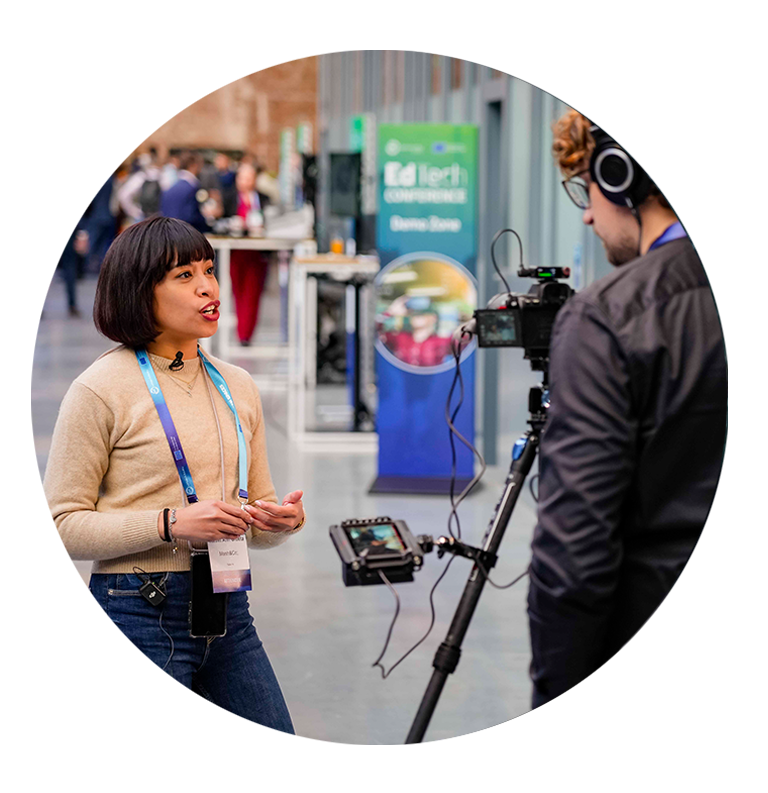
Watch the testimonial video from the first EIT EdTech Conference below.
The first EIT EdTech Conference took place on 24 January 2024 in Brussels.

100+ High level attendees
3 Interactive workshops
3 Keynote speakers
2 Panel discussions
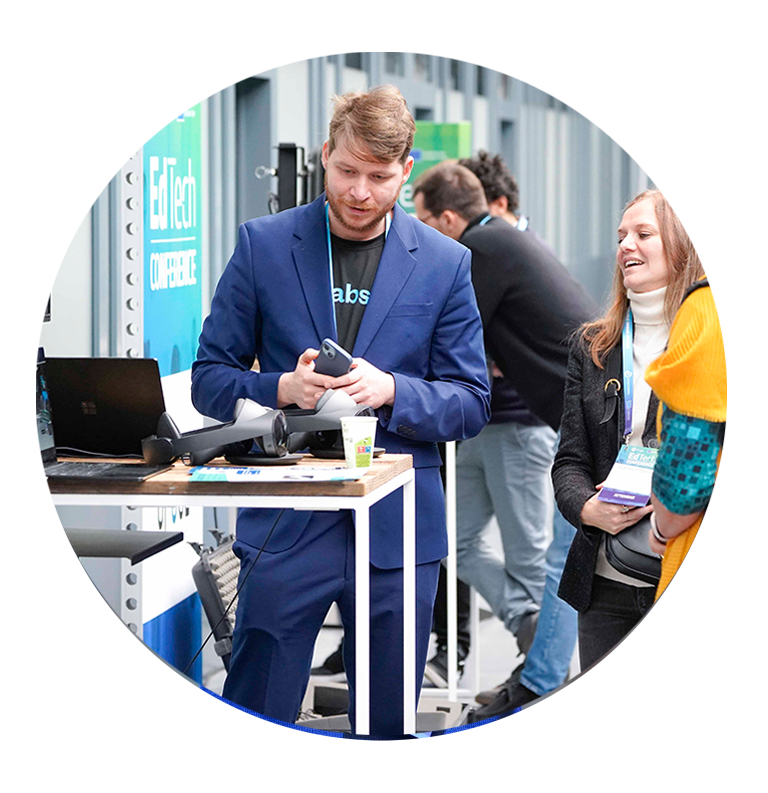
Demo Zone
Further Demo Zone sponsors will be announced soon.
Beth Havinga, Managing Director, European Edtech Alliance Originally a high school teacher from Australia, Beth Havinga has managed education publishing houses and education software companies in Europe, founded her own EdTech startups in Germany and the USA, and, for the last six years, has supported a wide variety of education organisations through her company, Connect EdTech. Beth works with large tech corporations, education publishers, governments, ministries of education and education startups globally, supporting them in education policy, digital implementation strategies, market analyses, and the internationalisation and expansion of digital products. She currently serves on the practical advisory board of Kids.digilab.Berlin.
As a specialist in the digitisation and interoperability of education systems, Beth currently serves on the Digitisation Council of the state of Berlin in Germany, is chair of the advisory board of Kids.Digilab.Berlin, and also represents Germany as head delegate to the European Committee for Standardization of Interoperability for Learning Technologies and EdTech. Additionally, Beth is part of the EdTech Roundtable of the European Commission, represents the EEA as part of UNESCO’s Broadband Commission, and is part of the COSN international advisory board.
Beth has previously served on the expert committee of the Austrian Ministry of Economy, Research and Science, and was an invited member of the expert Platform, “Digital Future: Learning. Researching. Knowledge” of the German Digital Summit under the Chairmanship of the German Education Minister.
As a cofounder of the European Edtech Alliance, Beth is excited about making the digital education landscape within Europe more accessible, interconnected and open for innovation.
Salvatore Moccia Head of Education and Skills, EIT Digital Biography available soon.
Prof. Tuula Teeri, CEO, Royal Swedish Academy of Engineering Sciences (IVA) Professor Tuula Teeri (PhD) is currently leading a diverse spectrum of activities for science-based policy advice as the President of the Royal Swedish Academy of Engineering Sciences (IVA), Chair of Euro-CASE (European Network of Engineering Academies) and Board member of SAPEA (Science Advice for Policy by European Academies). She has held research and leadership positions at VTT Technical Research Centre of Finland and KTH Royal Institute of Technology in Sweden where she was appointed Pro Vice Chancellor in 2008. During 2009 – 2017 Tuula Teeri was the founding President of Aalto University, leading the merger of three Finnish universities in technology, business, and design. The unique profile at the intersection of art, science, business, and technology, as well as student driven entrepreneurship has become an international benchmark of university reform.
Sean O’Reilly, Academic Affairs and Data, Technological Higher Education Association Sean O’Reilly has worked with the national representative association for Ireland’s technological higher education sector (Technological Higher Education Association, THEA) since 2012, in a number of roles supporting the rapidly evolving Technological Higher Education sector in strategic, data-driven decision-making, change management and quality enhancement. Sean works particularly with Registrars / Vice-Presidents of Academic Affairs, but also other key networks, and represents member institutions on several national groups. Sean represents THEA on the Steering Board for a €40m National Recovery and Resilience Programme in technological universities, funded by #NextGenerationEU. The programme focuses on empowering students, developing staff capabilities, and enhancing the digital ecosystem (www.transforminglearning.ie).
Prior to returning to Ireland, Sean worked for almost 20 years with schools in the United Kingdom, ultimately leading ICT developments for 130 schools and acting as school inspector. This role included setting strategic direction for primary and secondary schools’ use of ICT, and managing a EU-funded project to invest in 600 sites, including SMEs, across a sub-region.
The EIT EdTech Conference is organised by EIT Community and coordinated by EIT Urban Mobility. It is an initiative of the European Institute of Innovation and Technology (EIT), working to encourage positive changes in cities to make them more liveable places.
Coordinated by:
Organised in collaboration with:
The formal sponsorship packages can be viewed in the brochure, for alternative packages such as sponsoring products, event wifi & more get in touch to discuss opportunities at EIT ’s EdTech Conference 2025 by contacting eitedtech@forum-europe.com.
European Year of Skills, European Union Initiative
The EGG Brussels, Rue Bara 175, 1070 Bruxelles, Belgium
For more information on any aspect of this event, please contact the events team.
Privacy Policy | Cookies Policy | Terms and Conditions | Booking Terms and Conditions | Registered in UK
Registered Office: 5 Sovereign Quay, Havannah Street, Cardiff CF10 5SF